Skip to content

Wikidata Query updates

In my last post, I talked about Wikidata Query (WDQ), a web API and tool to run complex queries on the Wikidata corpus. There has been some interest in this system “as is”, but also into the possibilities of using the code in third-party tools. While the code (C++, if you want to know) is open source, at the time it was developed for this specific web service. Even loading the data was clunky: a Wikidata dump had to be processed by a PHP (!) script into a tabbed file format storing claims, and then piped into the actual service.

Now, things have changed for the better! For one, the code has been reorganized into three parts:

  • A shared “core” code for reading data, storing it in RAM, and running queries
  • The web server running the API and query tool
  • A simple tool for rudimentary tasks around WDQ, also serving as a demo for how to write your own tools

A second improvement is the ability to read (decompressed) Wikidata XML dumps directly. Not all information is currently used; labels, descriptions, wiki-links, qualifiers, and sources are ignored; however, with the exception of qualifiers, these have limited value for data queries.

While this does away with the PHP script, the latest Wikidata dump (September 22, 2013; 1.8GB, bzip2-compressed) still takes a whooping 42 minutes (tested on the WDQ machine) to read into memory. While this time can undoubtedly be improved, a significant part of that time (30%, by my rough estimate) is reading, decompressing, and piping the XML, which can not really be improved much.

So, as a third improvement, I am introducing a bespoke binary format. Like the XML parser above, it is incomplete, but sufficient for the task at hand. What is the advantage of this? First, file size: The 1.8 bzip2 dump file shrinks to 224MB (uncompressed), or about 12%. While this format is highly “lossy” by omitting a lot of information, it still carries all the data necessary to perform WDQ queries.

The second, and more important, advantage is load time, which goes down from 42 minutes to 25 seconds, or 1%. WDQ requires ~500MB of RAM to hold this data in a query-able way. Yes, this is for the entirety of Wikidata as of last week, including:

  • 4,239,729 monolingual strings
  • 265,770 time/date values
  • 749,051 coordinates
  • 15,284,254 item-to-item connections

I hope that these, and future, improvements will get people more interested in this code base, and maybe volunteers to help me improve and maintain it, and of course people to adapt it for their own tools. After all, Wikidata just got a bit more accessible.

Wikidata Query

With over 13 million items, Wikidata is a vast repository of human- and machine-readable data, and with over 70 million edits in the last 11 month, its value as a data repository is growing fast. Much of that value is stored in statements about items, and the connections between items.

42 might take a while

Surprisingly, ways to query this data behemoth are quite limited. There is text search, which will find you items with certain labels, and there is an API which can get information about a specific item and its properties. And yet, a way to ask more complex questions is nowhere in sight. Getting a list of people born in New York is currently impossible, without resorting to rather slow and tedious third-party tools (I should know; I wrote some of them). “Simple” queries are being worked on, but due to personnel priorities, as well as the nature of the underlying data storage, it might be quite a while to get answers to compound queries from Wikidata itself.

Worse, even if statements were present as “proper” database tables (they currently exists only as JSON blobs, if you really want to know), developers would be faced with a variety of the “category tree” problem that we all know and love on Wikipedia: Trees are not quickly and easily searched in databases, turning category tree intersections and related operations into horror stories to scare other programmers around a virtual campfire. Several variations of “CatScan” exist, but cannot really solve these issues. The same kind of challenges will hit Wikidata for “subclass of” and “parent taxon” chains that need following and branching.

So, a while ago, I asked the Wikidata section of Wikimedia Labs for a server to try out an idea of mine: What if I could keep the entirety of Wikidata in memory, as one giant, interlinked data structure? Is that possible? Would complex searches be quick enough? To make a long story short: Yes, and yes 🙂 The machine, with the software I dub “Wikidata Query” (WDQ for short), has been online for a while, and some people know about it, but with some recent updates to the code, interface, and documentation, I felt it’s time to write it up in a blog post.

The bridges of Germany

wdq

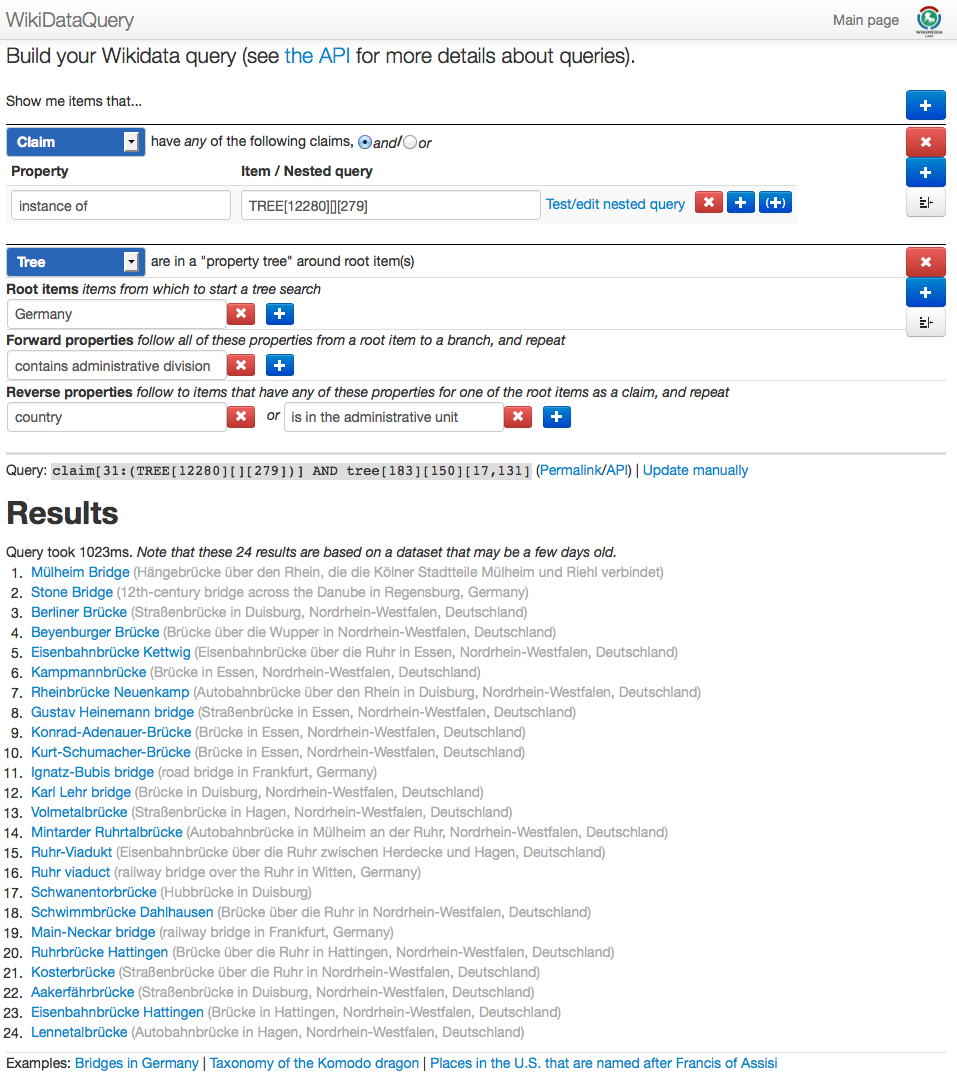
The query designer with the “bridges in Germany” example query.

Why does this need to be so complicated? What is the problem I am trying to solve? Let’s look at an example: I want to get a list of all the bridges in Germany. This sounds simple enough at first, but the devil is in the detail. What is a bridge, at least in Wikidata? Well, obviously anything that is an “instance of: bridge”, right? Right. And wrong, because that would be incomplete. This is a bridge in Germany, but it is an “instance of: railway bridge”, with “railway bridge” being a “subclass of: bridge”. This is a “direct” subclass, but since there is no “chain length limit” in Wikidata, this might go over several “subclass steps”. Thus, a bridge in Wikidata is an “instance of” anything that is a “subclass of” bridge, or “subclass of subclass of” bridge, etc. Basically, we need to construct a “reverse subclass tree” (reverse because we follow “incoming” links from the root) of everything that has “bridge” at its root, and get all the instances of all these bridge subclasses.

Now we have a list of all bridges. ALL bridges, worldwide. But we want only bridges in Germany, remember? So, how do we know that something (bridge or otherwise) is in Germany? As you might have guessed, “country: Germany” is not going to cut it. This time, we need all items that are leafs of the “is in administrative unit” reverse tree that can be traced back to the root “Germany”. For the previously mentioned bridge, that’s five hops.

“All” we need to do now is to find the items that are in both the “bridge” and the “Germany” lists of items, and we’re done! This sounds like a lot of work, and it is! However, thanks to the in-memory implementation (currently taking an easy 9GB of RAM, including multilingual item labels), this query takes only 0.8 seconds, which is quite reasonable IMO.

Designer code and raw query power

While this works nicely, and could be the basis for many other tools, constructing the query (which in this case, is obviously “claim[31:(TREE[12280][][279])] AND tree[183][150][17,131]” ) requires some basic programming skills, and a lot of time to find the item and property IDs. Also, the JSON output, while perfectly machine-readable, is not exactly easy on the eye. Therefore, I also wrote a query designer that should cater to a larger audience. It offers combinations of searched for claims, negative claims (“does not have a claim/property”), perfect matches for strings (e.g., “has this VIAF ID”), and the aforementioned chains or trees.

Due to lack of manpower, the query designer does not (yet) cover all possibilities the API offers. Manually constructed queries can search for date ranges per property (as in “born between dates X and Y”), or for locations around a point. All of these can be combined with AND/OR, grouped, and (in some cases) use nested subqueries, which makes the query language quite powerful.

There are a few minor drawback in all of this: WDQ is based on the Wikidata dumps, static snapshots that are made at more-or-less regular intervals. I do update WDQ with the daily “differential” dumps, so it should never be more than 24h out of date, but in the ever-changing world of Wikidata that can feel like an eternity. Also, neither qualifiers nor sources are supported yet.

If you would like to build your own tools on top of WDQ (which I would welcome very much!), have a look at the API documentation, with details on how to construct a query, and advanced/experimental features such as properties and labels. I would also welcome help with maintaining, improving, and extending the code (hereby GPL 2+, code on Bitbucket).
Autodesc

Search results containing both manual and automated descriptions (highlighted in blue).

Search results containing both manual and automated descriptions (highlighted in blue).

Wikidata offers multilingual labels for items. Since many items will have the same label with, or even across, languages, one can also add a brief description for an item in each language, to quickly disambiguate between them. Such descriptions are helpful in searches, and essential when adding claims linking to other items. However, many items that share the same label have not been described by users yet, and most non-ambiguous items have no description either.

But many items already have claims describing their basic properties. So why leave the tedious task of describing all items in all languages to humans? A “well-claimed” item can, to some degree, be described by a machine, based on its claims. While such “machine description” is limited by both the algorithm used and the claims in the item, and automated descriptions will be misleading in some cases, they can be useful in most cases, and are easily corrected by entering a manual description.

For starters, I have created a JavaScript object I dub “autodesc” (for “automatic description”, not CAD development!). It generates automated descriptions for search results where no manual description is available. This happens “live”, even in the search dropdown box while you type. Automated descriptions are highlighted, so one can easily distinguish them from manual descriptions.

Dropdown autodesc

Automatic descriptions are added to the dropdown search box as well.

At the moment, the interface text is in English only, but it should work with all languages (limited by Wikidata item translations), albeit with some English text and strange grammar. The object is designed with multi-language support in mind, though.

Sadly, the “killer app”, that is, automatic description of items when editing claims, does not quite work yet, but it should not be a major technical hurdle.
UPDATE:I figured it out, this is now live!

If you have a Wikidata account, you can add this functionality by visiting your common.js page and adding the following line:

mw.loader.load('//en.wikipedia.org/w/index.php?title=MediaWiki:Wdsearch-autodesc.js&action=raw&ctype=text/javascript');

Needless to say, this is still experimental and may break at any point. I would love some help in developing it, and maybe the Wikidata devs might pick up the code, or at least the idea.

UPDATE: changed the URL to load from English Wikipedia instead – can be edited by the community, and scales much better under load than Labs

How to nip a budding project

Wikidata is booming. A huge number of editors, many of them new contributors to the Wonderful World of Wikimedia projects, are adding, fixing, and sourcing claims to the database. A ridiculously high amount of language links have been moved from Wikipedia to Wikidata. Part of the promise of this new project is to unify factoids across the different language editions of Wikipedia; another is to make the key facts of Wikipedia (and other sources) accessible in a machine-readable form for third-party users. For those users, which will probably outgrow the use of claims on Wikipedia in the long run, the amount of (reasonably reliable) data is paramount. Wikipedia really took off once it reached a critical mass of useful knowledge; the same is due to happen to Wikidata.

Or is it? When it comes to claims and statements, a huge amount of heavy lifting has been, and is being, done by bots. The idea is simple; there is a lot of simple, factual data that can be extracted from a Wikipedia article and inserted into the corresponding Wikidata item, using categories, templates, or specific matches in the article text itself. For proper provenance, bots usually add “imported from en.wikipedia” as a “source” to the imported claim.

But this well-working system is about to end, sabotaged by people obsessing with “proper sources”. Now, don’t get me wrong; I do think all statements in Wikidata should be sourced properly! It is a tremendous opportunity to link the world’s knowledge up in the most fine-grained form imaginable. It is, undoubtedly, the right thing to do. But the drive to enforce this now, for all bots, is premature. Mainly because it is impossible.

I know. I created a list of birth and death dates from Wikipedia articles. Over 300.000 Wikidata items about people could have that information, in a matter of hours. But this has been verboten by the bureaucracy, as the dates do not have proper sources. Non-technical people may ask, “so why not just add sources”? I’d love to; except, it might be somewhat hard to have a bot scan the sources in the Wikipedia article, go to a library, get all the books, read them, find the mentioned dates, return the books, find or create the book items in Wikidata, and link them up accordingly. A bot couldn’t source web resources either (even if it would somehow know which one to use), since there is currently no URI type on Wikidata.

So all these dates will have to be entered and sourced manually, by a human. And this is why it’s the wrong approach; it doesn’t scale, even in the Wikimedia world, which is not exactly lacking volunteers. It could be done eventually, but the flame of hope that is Wikidata now will have faded by then. Facts on Wikipedia have been checked to a high degree, as was demonstrated time and again. The important thing right now is to get these facts into Wikidata, to keep the momentum, to get others interested in using, and working with, Wikidata as a machine-readable knowledge repository. Sources will, and should, be added. In due time.

In the pipeline

Over the years, the toolserver, mostly organised and financed by Wikimedia Deutschland, has become an invaluable asset to many Wikimedia projects. However, the open access policy of the toolserver, which enabled many volunteers to write helpful tools, comes at a price. Most tools are “stand-alone”; they perform a single function, and the results are usually a “dead end”, in the sense that they cannot be used by another tool. That is despite the fact that many tools output, in essence, page lists, with or without additional metadata.

The UNIX philosophy states that programs should be able to perform only a single function, but do that very well; multiple programs can then be “chained” into a pipeline, where the output of one program becomes the input of the next one. The toolserver has single-purpose-tools aplenty, but so far lacks the ability to pipeline them.

Here, I present my pipeline editor, an attempt to bring the pipeline part to the toolserver. It uses my tools to manage assets, especially list of (annotated) pages on Wikimedia projects, to chain tools together. The individual tools are run asynchronously on the toolserver, in the “background”; the status of the currently running tool is updated every few seconds. A full pipeline consists of three parts:

  1. An initial step to generate input data. Currently, one can either paste a list of pages as text, or run my CatScan rewrite to generate such a list from category trees. You can also use an existing asset ID, which allows for computationally “cheap” experimentation on an existing dataset.
  2. Any number of intermediate steps. Currently, I only offer a filter based on links and page sizes, but there could be any number of filters or “annotators”: Filter for pages without images? Or those that have last been edited by a human over a year ago? Or “annotate” the pages with potential free images from Commons or Flickr?
  3. The end or viewing stage. At the moment, this only shows a link to view the resulting asset (annotated page list), but there could be other viewing interfaces, or even Wiki(m|p)edia-editing bots.

While the current number of tools for the pipeline is rather sparse, basically any tool on the toolserver that processes or outputs lists of Wiki pages can be integrated, either by altering the tool itself to work with the asset system, or by using a bespoke “wrapper” tool. Also, saving and re-using of pipelines is something I plan to add soon. I am looking forward to your feedback and tool suggestions!


Shoot me!

In my continuing “toolspam” series, I would like to introduce a tool for all Wikimedians traveling with a camera (and maybe a smartphone), and the will to use it. I call it Wiki ShootMe!. (Continued)

Commons Commander

After many years of resistance, I have finally succumbed to the temptation of blogging (just when blogs come out of fashion, it seems…). I would like to start by writing about something rather familiar to me: some of the tools I developed for Wikipedia and other Wikimedia projects. I hope to reach more people than on the odd mailing list, while making it easier to ignore my ramblings. (Continued)